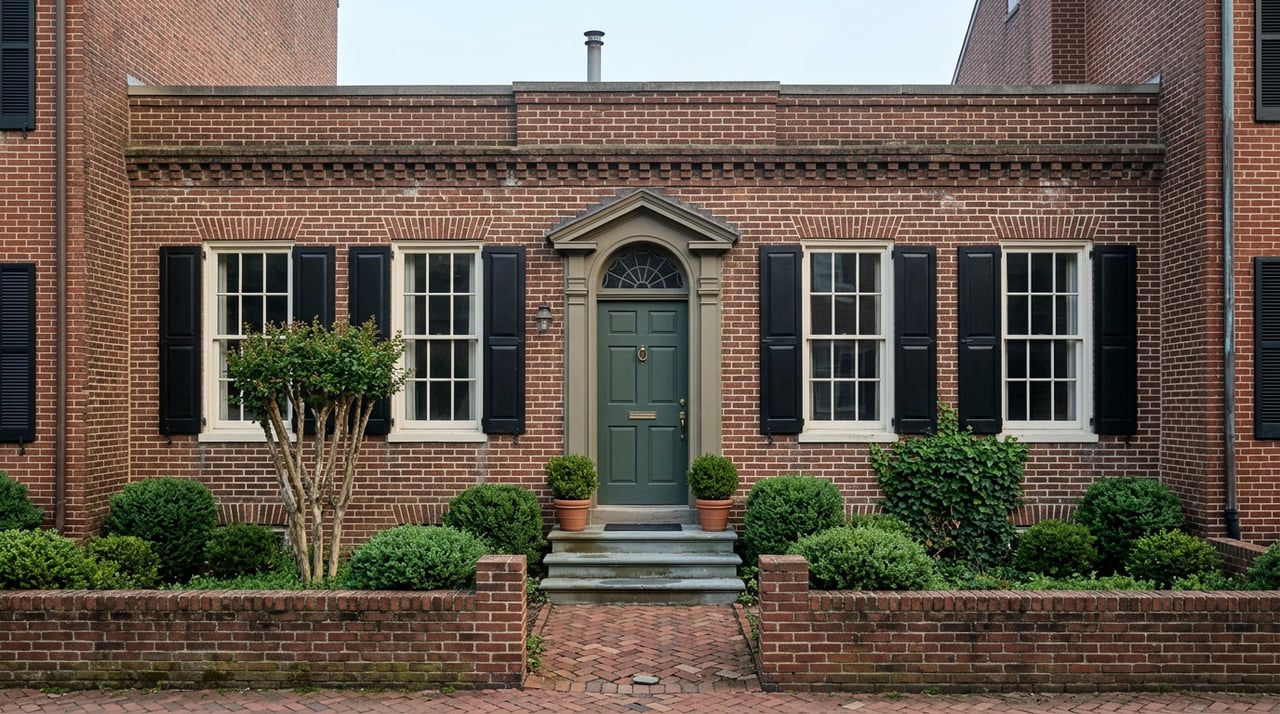
What Alexandria's BAR Rulebook Rewrite Means If You're Buying or Selling in Old Town This Fall
September 24, 2026
September 24, 2026
Say you're two weeks from closing on a rowhouse in Old Town. The inspection came back clean, your lender is queued up, and somewhere in the disclosure packet is a line about the property sitting inside a local historic district. Does that change anything about your timeline?
Normally, not much. You'd file it away as one more thing to ask about if you ever want to swap the front door or add a deck. But this fall the answer is more complicated, because the rulebook governing exterior changes in Old Town and the Parker-Gray Historic District is being rewritten for the first time since 1993, and the rewrite is landing in the middle of a market where the wrong assumption about timing can cost you a season.
Alexandria's Board of Architectural Review has real teeth. Any exterior change visible from a public street inside the Old and Historic Alexandria District or the Parker-Gray Historic District needs a Certificate of Appropriateness from the board before the city will even accept a building permit application, and a Permit to Demolish is required for any demolition or removal of more than 25 square feet of material regardless of whether it's visible from the street. Interior work is exempt. Everything else runs through the board.
The design guidelines that tell staff and board members what "appropriate" means were written in 1993, before video doorbells, EV charging, or small cell antennas existed as categories anyone needed to regulate. This summer the city's Design Guidelines Committee posted 11 draft chapters covering electric vehicle chargers, HVAC equipment, exterior lighting, security features, porches, decks, and balconies, and opened them for public comment. Alexandria held a community meeting on August 19 at the Nannie J. Lee Memorial Recreation Center, the comment window closed September 2, and city staff have said the revised guidelines are expected to go before the Board of Architectural Review for formal adoption hearings in October. A second batch of 12 chapters covering storefronts, additions, accessibility, and demolition is scheduled for review in early 2027. The rules apply to roughly 5 square miles of the city, the footprint of the two locally regulated historic districts plus properties on Alexandria's 100-Year-Old Buildings list.
The draft chapters sort every project into one of three tiers: no review needed, staff can approve it administratively, or it goes to a full board hearing. A few specifics worth knowing before you plan a project or price a listing:
At the August meeting, residents pushed back on specifics around EV charging, airport noise, and single-pane windows. City planners clarified that the guidelines function as qualitative standards the board applies when reviewing a Certificate of Appropriateness, and that failing to meet them can still be grounds for denial even though they aren't a strict numeric code.
Here's the detail that surprises people who assume "historic district" means one set of rules. The two districts sit under the same board, but the draft chapters treat them differently on at least two categories that come up constantly in renovation planning.
| Project | Old and Historic Alexandria District | Parker-Gray District |
|---|---|---|
| Rooftop HVAC installation | Every installation goes to the full board | Staff can approve units set at least 15 feet behind the front facade; a hearing is only required if it's closer to the street |
| Rooftop equipment screening waiver | Reserved to the board | Staff can waive the screening requirement administratively |
| Demolition of a small accessory structure | Board review required for any demolition | Structures up to 100 square feet in a rear yard can be demolished with no review, citing a zoning ordinance exemption |
If you're comparing a rowhouse in Old Town proper against one a few blocks over in Parker-Gray, and both need a new heat pump on the roof, you are not comparing equal renovation timelines even though both properties fall under the same board's authority.
Administrative approvals for minor work can move in days to a couple of weeks. A full board hearing typically runs 4 to 8 weeks from submission to decision, and larger additions or more complex projects can stretch past that. That's the process side.
On the market side, Alexandria's sales pace as of August 2026 tells a different story. Citywide sales were down sharply that month, 130 closed transactions compared to 182 a year earlier, a 28.6 percent drop. But the homes that did sell moved for more: attached homes, the rowhouse and townhouse stock that makes up most of Old Town and Parker-Gray, averaged $727,164, up 13.6 percent year over year, while the smaller pool of single-family sales averaged $1.5 million, up 14.7 percent. Average days on market ticked up only slightly, to 26 days from 24 the year before. Redfin's trailing three-month figure for all Alexandria home types put the median sale price at $749,990 as of August 2026, up 9 percent year over year.
Put those two clocks side by side and the mismatch is obvious. A typical Alexandria sale is moving in under a month. A full BAR hearing takes two to three times that long, sometimes more. That means you cannot treat a deck, an EV charger, or a rooftop HVAC swap as something you'll sort out during the option period or add as a closing concession. If the project needs board review, it needs to already be approved, in progress, or explicitly priced into the deal before the property ever hits the market.
Properties in Old Town and Parker-Gray have often changed hands multiple times over 150 to 200 years, and it is not unusual for a prior owner to have replaced a window, added a structure, or altered a facade without ever pulling a Certificate of Appropriateness. Those gaps show up in the city's permit records, and they can complicate a transaction for a buyer's lender even when the seller had no idea the work was ever out of compliance. Before you list, it's worth pulling the permit history on your own property through the city's APEX system rather than finding out about a gap during a buyer's due diligence period. The clearer administrative tiers in the new guidelines, especially around window units, small cameras, and non-visible decks, may make it easier to document that certain existing features never needed review in the first place. But anything larger, like an existing deck visible from the street or a security camera over a cubic foot, is worth checking against the draft standards now rather than after you're under contract.
If part of your plan for an Old Town or Parker-Gray property includes an EV charger, a rooftop deck, or a new HVAC system, check which district the home sits in before you assume how quickly you can act. A side-yard charger under the 48-inch handle limit is a straightforward case almost anywhere. A rooftop HVAC swap in the Old and Historic Alexandria District goes to the full board regardless of where it sits on the roof, while the identical project in Parker-Gray might clear staff review if it's set back 15 feet from the front facade. Budget the board's timeline into your first year of ownership, not your closing schedule, and ask your agent or the city's preservation staff to confirm the current tier for your specific project before you finalize any post-purchase renovation plans.
Does this affect homes outside Old Town and Parker-Gray? No. The guidelines only govern the roughly 5 square miles inside the two locally regulated historic districts and properties on the city's 100-Year-Old Buildings list.
When do the new rules actually take effect? The 11 draft chapters closed for public comment on September 2, 2026, and city staff expect the Board of Architectural Review to hold formal adoption hearings in October. A second round of 12 chapters covering storefronts, additions, accessibility, and demolition is scheduled for review in early 2027.
Does interior work need approval? No. The board's authority covers exterior features visible from a public right of way. Interior renovations are outside its scope entirely.
Old Town's charm has always come with a process attached, and that process is finally catching up to the century it's operating in. If you're weighing a listing timeline, a renovation plan, or an offer on a historic property this fall, the details in this rewrite are worth walking through before you commit to a date. The Gaskins Team works Old Town and Parker-Gray regularly and can help you sort out what a specific property's approval path actually looks like. Let's connect — get your free home valuation or market consult.
Stay up to date on the latest real estate trends.
Whether you're buying your first home or preparing to sell, The Gaskins Team is here with the strategy, support, and local expertise to help you succeed.